Happy Birthday Cookie Cutter Set: A 3D Printed Toolkit for Celebration
In the realm of custom baking and celebration crafting, digital tools have become as essential as flour and sugar. The Happy Birthday Cookie Cutter Set represents a specific category of these tools: a collection of 3D printable STL files designed for creating themed baked goods. For those equipped with a 3D printer, this set transforms a digital download into a physical tool, offering a modern approach to personalizing birthday cakes, cookies, and other celebratory treats.
Core Functionality and Design Characteristics
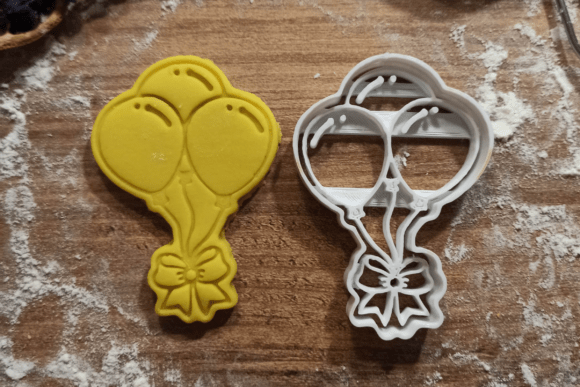
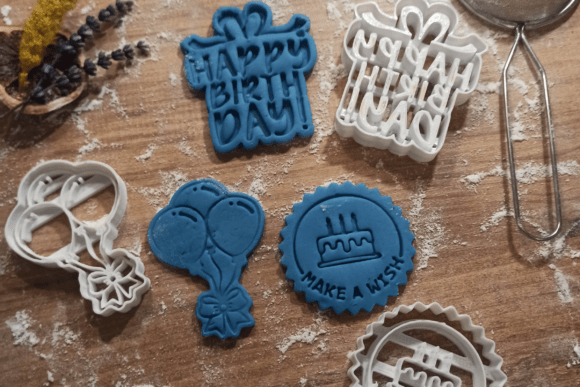
The set consists of three distinct cutter designs, each corresponding to classic birthday iconography: a balloon, a layered cake with a "Make a Wish" banner, and a gift box. These are provided as STL files, the standard format for 3D printing. The primary purpose is to enable the creation of consistent, reusable cutters for shaping fondant, gum paste, cookie dough, or similar malleable materials. The value lies not in a physical product shipped to you, but in the ability to locally manufacture a durable tool with precision.
A key strength is its digital nature. Instant download eliminates wait times and shipping costs, and the files can be printed as many times as needed, allowing for replacement or creating multiples for batch production. The designs are inherently three-dimensional, meaning they create a cutter with depth, suitable for thicker materials like fondant layers on cakes. This contrasts with simpler, flat-laser-cut cookie stencils.
Practical Performance and Usability Considerations
In real-world use, the performance of the Happy Birthday Cookie Cutter Set is intrinsically tied to the user's 3D printing setup. The quality of the final cutter depends on printer calibration, layer resolution, and the material chosen for printing. Using a rigid PLA or ABS plastic will yield a sturdy, dishwasher-safe tool, while a resin printer could produce a cutter with exceptionally smooth edges. Consistency is high, as each print from a properly sliced file will be identical, a significant advantage for professionals needing uniform decorations across multiple products.
Usability is straightforward for anyone familiar with basic 3D printing workflow: download, slice with preferred settings, and print. The flexibility is noteworthy. While designed for birthday themes, these clean, generic shapes could be repurposed for other celebrations—a gift box cutter for holidays, a cake shape for anniversary desserts. Their reliability is mechanical; a well-printed plastic cutter will not wear out quickly with gentle use on soft materials.
Audience Fit and Professional Applications
This set aligns particularly well with certain user profiles. Serious hobbyists and home bakers with access to a 3D printer can elevate their family celebrations with custom, professionally-shaped decorations, moving beyond simple hand-cutting. For freelance cake decorators and small baking business owners, the set offers a low-cost way to add a signature branded touch to birthday orders. Printing several sets allows for efficient workflow during peak seasons.
Educators in culinary arts or maker spaces might use these files to demonstrate the intersection of digital fabrication and traditional crafts. Bloggers and content creators focused on DIY baking can utilize the cutters to produce visually consistent, attractive content for tutorials and social media. The set is less relevant for those without 3D printing capability or for professionals who already possess extensive physical cutter collections covering these common shapes.
Evaluating Long-Term Value and Potential Limitations
The long-term value is favorable. The digital files are a permanent asset. As printer technology advances, one can re-print the cutters at higher resolutions. The designs are timeless, ensuring they don't become obsolete. From a cost perspective, the initial file purchase plus minimal material cost for printing typically amounts to less than buying three quality metal cutters, though it requires the upfront investment in a printer.
Potential limitations must be acknowledged. The cutter's effectiveness on very hard or sticky materials might be limited compared to industrial metal cutters. Edge sharpness depends on print quality. There is also a learning curve; users must be comfortable with 3D printing basics, including file orientation, support generation (if needed), and material selection to avoid failed prints. The set provides the shapes but does not include guidance on optimal print settings, which requires user knowledge or experimentation.
Integration into Creative and Business Workflows
For a home user, integrating the Happy Birthday Cookie Cutter Set might involve printing it once and storing it with baking tools for annual use. For a professional decorator, it becomes part of a digital toolkit. They might print a set, use it to rapidly shape fondant for fifty birthday cakes in a month, and appreciate the time saved versus manual cutting. It fits into a workflow that prioritizes customization and efficiency, especially when paired with other digital design elements.
The presentation of the final product—a cake adorned with a perfectly uniform fondant balloon or gift box—is polished. This visual effectiveness meets audience expectations for professional-grade celebratory goods. In a business context, it can enhance product consistency, a key component of brand trust.
Whether this set fits your needs depends on your tools, goals, and frequency of use. If you possess a 3D printer, regularly create birthday-themed baked goods, and value consistent, reusable tools, the Happy Birthday Cookie Cutter Set is a practical and effective digital asset. It bypasses traditional manufacturing and supply chains, putting the tool creation directly in your hands. If you bake only occasionally for birthdays or lack printing access, its utility diminishes. As a focused set of functional files, it serves its stated purpose reliably, offering a clear upgrade from improvised cutting methods for those in its target audience.