Death Claus: A Macabre Twist on Festive 3D Printing
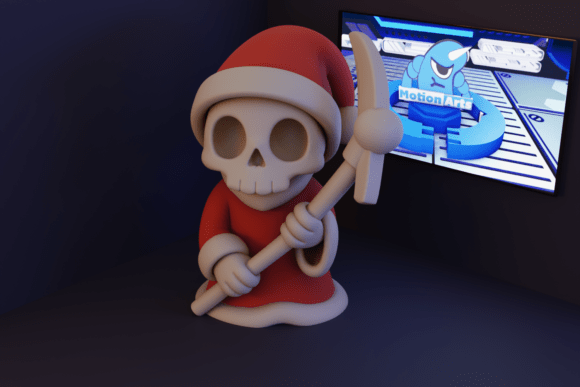
The holiday season is ripe with tradition, but for those who find the usual jolly Santas and grinning elves a little too predictable, a new kind of merry has arrived. Death Claus is a cartoon-style 3D model that artfully merges the grim reaper with Santa Claus, creating a piece where dark humor meets festive cheer. This isn't merely a novelty; it's a thoughtfully designed STL file built for reliable printing and creative expression, offering a unique avenue for personalization in your seasonal projects.
Why Death Claus Resonates Beyond a Simple Model
At first glance, Death Claus is a conversation starter—a perfect oddity for an alternative holiday mantle. But its value extends deeper. For creators and hobbyists, it represents a specific design challenge that balances artistic theme with practical manufacturability. The model features a solid structure, balanced proportions, and a stable base, decisions made not just for aesthetics but to ensure a successful print. This means you spend less time troubleshooting failed prints or correcting design flaws and more time on the enjoyable parts: painting, finishing, and displaying.
Consider the typical holiday decorator or collector seeking something distinct. Standard decorations can feel impersonal. Death Claus allows you to produce a truly custom piece that reflects a more nuanced sense of humor or artistic taste. It strengthens your creative communication, letting your decor tell a more complex story than a simple "Happy Holidays." For a small business owner selling niche gifts or a content creator crafting a unique holiday atmosphere for streaming or photos, this model provides a ready-made asset to elevate their visual presentation with originality.
The Practical Benefits of a Well-Engineered Design
The developer's focus on a "clean finish" and compatibility with both FDM and resin printers is a key benefit. This duality saves you from having to choose one specific file for your printer type, simplifying your decision. An intermediate-level model requiring supports, it is designed to be approachable without being overly simplistic, offering a satisfying project that can improve your printing skills. The reliable outcome means you can confidently integrate it into a planned holiday activity, like a themed painting workshop with friends or as part of a curated collection you intend to display by a specific date.
For the educator or workshop leader, Death Claus can serve as an engaging project to discuss themes of design adaptation, cultural mashups, and 3D printing techniques. Its clear requirement for supports makes it a practical case study for teaching post-processing skills. The fun painting stage invites experimentation with color schemes that subvert expectations—perhaps a traditional red robe with unexpectedly eerie highlights—supporting creative goals beyond the print itself.
Identifying the Ideal User and Considering Fit
This model will resonate most with adults who already appreciate alternative art, dark humor, or pop culture mashups. It’s for the hobbyist who has moved past basic calibration cubes and wants a themed project with character, or the professional who needs a unique physical prototype for a client in the entertainment or boutique retail sector. It's also perfectly suited for fans of creative and unusual themes looking to personalize their space with something that cannot be bought off a shelf.
However, its intermediate level and need for supports mean it may not be the best first-ever print for a complete novice. Users should compare it against simpler festive models if they are still mastering basic adhesion and support removal. Furthermore, its aesthetic is deliberately niche. If your goal is to create a universally warm and traditional holiday ambiance, this model would be a mismatch. Its value is unlocked specifically when your intention is to spark curiosity, showcase a darker palette of humor, or demonstrate 3D printing's capacity for personalized, thematic art.
From Digital File to Meaningful Physical Object
The journey from downloading the STL to holding the painted figurine is where Death Claus proves its worth. The design’s emphasis on easy printing and fun painting directly increases efficiency in your workflow. You avoid the frustration of a fragile, poorly balanced model that snaps during handling or requires endless sanding. This efficiency saves time and material, allowing you to focus your effort on the creative customization that makes the piece uniquely yours.
Imagine the solved problem of finding a centerpiece for an "Alternative Christmas" party. Death Claus provides the solution. Or consider the blogger focusing on 3D printing reviews; this model offers a tangible example to discuss design considerations for dual printer compatibility. Each printed Death Claus becomes more than a decoration; it's a testament to a well-executed project, a catalyst for social interaction, and a concrete example of how digital design can solve specific, real-world creative needs.
Integrating Death Claus into Your Creative Ecosystem
Beyond a single print, Death Claus can inspire a suite of activities. A printed and painted model could be the star of a holiday photo series, enhancing your online content. For entrepreneurs, a small batch of printed and finished figures could form a limited-run product line for a niche market, testing small-scale manufacturing and finishing techniques. The model’s stable base and solid structure make it suitable for such ventures, as it is less prone to damage during handling or shipping compared to more delicate designs.
The blend of macabre and merry inherent in Death Claus also opens thematic doors. It can accompany storytelling, serve as a mascot for a seasonal event with a twist, or act as a gift that perfectly captures a friend's unique sensibility. In these use cases, the model supports goals of deepening engagement, strengthening personal or brand identity, and delivering an experience that is both functional and conversationally rich. It moves from being a simple printed object to an integral part of a larger creative or communicative strategy.
While the model guarantees excellent results in FDM and resin, the final outcome still depends on your printer calibration and material choice. This is not a limitation of the file, but a realistic consideration for any 3D printing project. Approaching Death Claus with a mindset geared towards creative finishing, rather than seeing it as a quick print-and-done item, will yield the most meaningful results. When you embrace the entire process—from slicing the supported file to applying the final coat of paint—you unlock the full value of this uniquely designed fusion of laughter and mystery.